The Rule of Three: Building Reliable Dog Obedience One Success at a Time
Discover professional dog trainer Scott Ward''s Rule of Three — a practical approach to reliable dog obedience through clear communication, fair training, patience, and consistency.
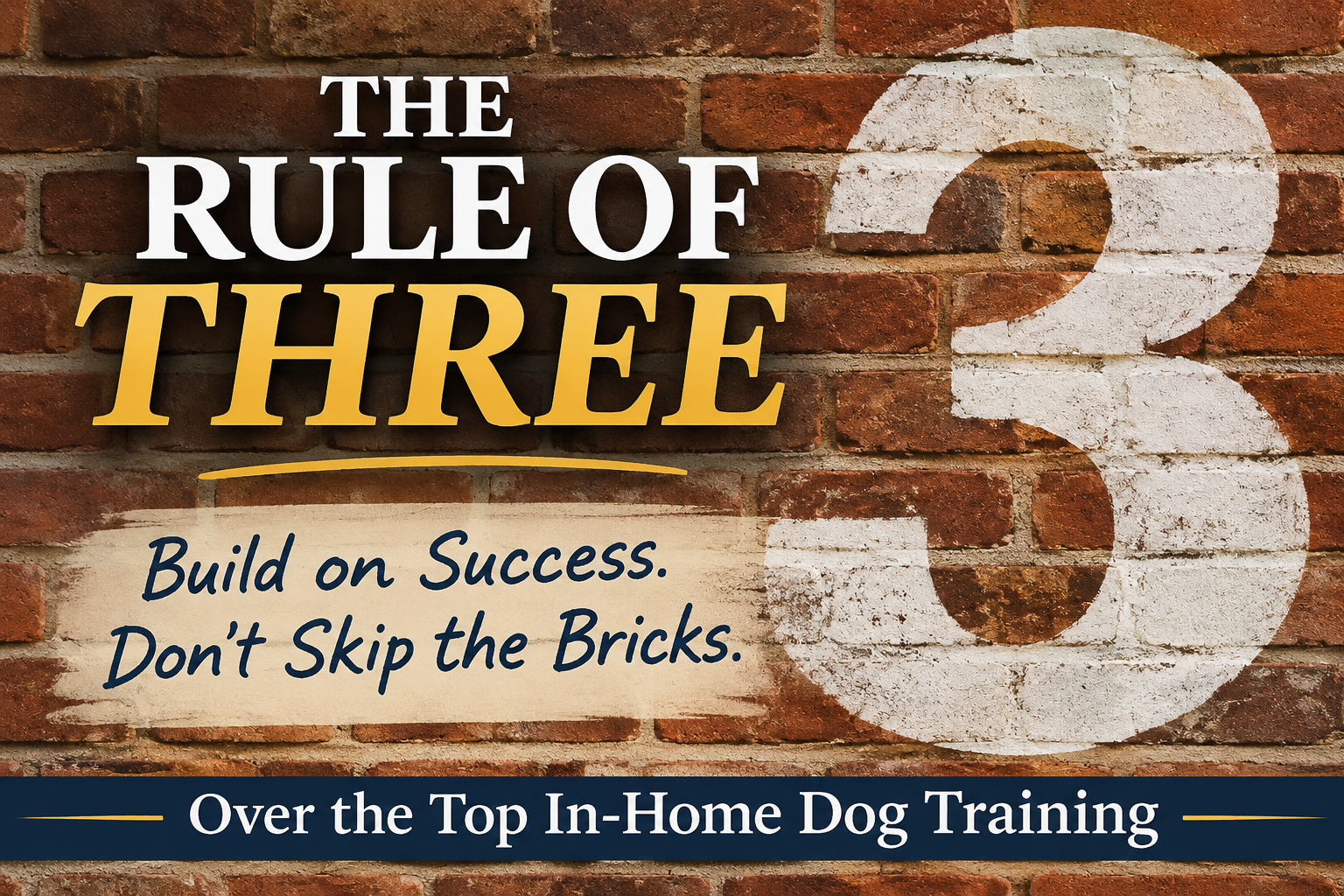
After approximately 25 years of professionally training dogs, there's one principle I've followed throughout my career. I call it the Rule of Three.
It's something I've used with everything from puppies learning their first commands to advanced competition dogs. It doesn't matter what I'm teaching. The principle remains the same.
I never want a dog to fail three times in a row, and I want to finish with three successful repetitions in a row.
It sounds simple, but there's a lot more behind it than just counting to three.
Don't Skip the Bricks
I've always compared dog training to building a house.
When you're building a house, the most important part is the foundation. You can take shortcuts, skip a brick here and there, and get the job done faster. The house might even look pretty good when you're finished.
But eventually, those shortcuts can catch up with you. If the foundation isn't solid, everything you've built on top of it is at risk.
Dog training works the same way.
Too many people want to rush to the next step. They want their dog working off leash before they've mastered on-leash obedience. They want their dog listening around distractions before the dog has a solid understanding of the commands.
They're skipping bricks.
And here's something I've learned over the years:
It's a whole lot easier to teach something correctly the first time than it is to undo bad habits and retrain a dog later.
Taking shortcuts doesn't necessarily save you time. Sometimes it creates more work down the road.
That's why I believe in building a solid foundation, one successful step at a time.
Understanding My Rule of Three
My Rule of Three has two important parts.
First, I don't want a dog to fail three times in a row.
If a dog makes the same mistake twice, I'm going to evaluate what's happening before allowing that mistake to become a pattern.
That doesn't mean I'm automatically going to correct the dog. Every dog and every situation is different.
Sometimes the dog is confused. Sometimes I've moved too quickly in training. Sometimes the distractions are too much. And sometimes the dog understands the command but isn't following through.
My job as a trainer is to recognize the difference and make the appropriate adjustment.
Second, I want three successful repetitions in a row before finishing an exercise.
I'm looking for the dog to perform the command independently, without needing additional guidance or corrections.
I use treats in training, especially when introducing something new. But I don't want a dog that only responds because I'm holding a treat in front of it.
Sometimes my reward might be a treat. Other times, it might simply be genuine praise and positive energy in my voice.
The goal is to develop a dog that understands what's expected and can perform reliably.
A Real-Life Example: Teaching the Place Command
Let's say you're sitting in your living room watching television.
You've given your dog the command "place," and you expect it to remain there until you release it.
Someone walks through the living room, and the dog gets up.
You put the dog back on place.
A minute later, someone walks through again, and the dog gets up a second time.
Now we're at an important point in training.
I don't want to sit there and allow the dog to make the same mistake a third time without changing something.
One of the biggest mistakes I see owners make is saying, "Well, he did it perfectly yesterday. I know he knows how to do it."
Maybe he does. But just because a dog performed a command yesterday doesn't necessarily mean he's ready to perform it today under different circumstances.
In this particular situation, I might decide to back up and simplify the exercise.
I could put a short leash or a 12-inch training tab on the dog. That gives me something I can quickly grab if the dog starts to leave place.
Now my timing and communication can be better. Instead of chasing the dog across the living room, I can calmly guide it back to place immediately.
I might also shorten how long I'm asking the dog to remain there or reduce the distractions until we're having success again.
The important thing is that I've recognized a problem and made an adjustment instead of allowing the dog to keep practicing the same mistake.
That's the first part of my Rule of Three.
Know When to Finish on Success
Now let's take that same example a little further.
I've made some adjustments, and the dog is starting to understand what I expect.
Someone walks through the living room, and the dog remains on place.
A little later, someone walks through again, and the dog still doesn't move.
We're making progress.
At this point, I'm not necessarily going to expect that dog to remain on place for another hour.
I might give it another couple of minutes, and if everything is going well, I'll release the dog and offer some praise.
Why?
Because I want to build on success.
When I'm practicing individual commands, I work toward three clean, successful repetitions in a row. When I'm working on duration or distractions, I'm looking for repeated success at a level the dog can handle.
Sometimes that means ending an exercise sooner than expected.
Too many owners keep pushing when their dog is finally doing something correctly. They want another five minutes, another distraction, or another challenge.
And sometimes that's when things start falling apart.
I'd rather finish with a dog that's succeeding than keep pushing until it makes another mistake.
Tomorrow, we can build on what we accomplished today.
Timing and Communication Matter
Another important part of successful dog training is timing.
A dog needs clear communication to understand what you're asking.
Whether you're giving a command, providing guidance, or offering praise, your timing matters.
When I praise a dog, I want that praise to mean something.
Dogs are very good at picking up on our tone of voice, body language, and energy. If I'm telling a dog "Good dog!" I want to put some genuine enthusiasm behind it.
But there's also a balance.
If you're constantly saying "Good dog" every few seconds, those words can start to become background noise.
Think about going to work. If your boss tells you every single day that you're doing an amazing job, eventually those words might not carry the same weight.
But when you've worked hard to accomplish something and your boss recognizes it, that praise means something.
Dog training is similar.
Praise at the right time, mean what you say, and make it count.
Never Let Your Temper Take Over Your Training
One of the worst things you can do in dog training is lose your temper.
I've always believed that you need to remain calm, patient, and in control of your emotions when working with a dog.
Dogs are extremely sensitive to our tone of voice, body language, and emotions. When you become frustrated, start yelling, or lose your temper, your dog can pick up on that.
And here's something I want every dog owner to understand:
When your dog is stressed, nervous, or confused, that's when it needs you the most.
Think about that for a minute.
If your dog is already struggling with something, and you become angry or frustrated, you're only adding more stress to an already difficult situation.
That's not a good combination, and it's certainly not going to help your dog learn.
There's a big difference between being firm and being angry. You can hold your dog accountable without losing your temper.
Sometimes the best thing you can do is back up, simplify what you're asking, and give your dog an opportunity to succeed.
And if you're becoming too frustrated to train fairly, there's nothing wrong with taking a break.
Your dog needs you to be the calmest one in the room, especially when things aren't going right.
Fairness and Understanding Come Before Corrections
One thing I've always believed throughout my dog-training career is that every correction needs to be fair.
Before correcting a dog, I need to be confident that the dog understands what I'm asking and has had a fair opportunity to respond.
If a dog doesn't understand what it's doing wrong, how can I expect it to understand why it's being corrected?
That's where people get into trouble.
When you start putting unfair pressure on a dog, especially when it's confused or nervous, you're not building understanding. You're creating frustration, stress, and potentially a poor attitude toward training.
And that's something I never want.
There's a difference between a dog that understands a command but isn't following through and a dog that genuinely doesn't understand what's expected.
As a trainer, it's my responsibility to recognize that difference.
A correction should never come from anger or frustration. It should be fair, properly timed, and appropriate for that individual dog.
If the dog doesn't understand, I need to back up and teach. Not simply apply more pressure.
Remember, the goal isn't to make a dog afraid of making a mistake. The goal is to develop a dog that understands what I'm asking and responds with confidence.
Fair training builds trust. Unfair pressure breaks it down.
A Well-Trained Dog Should Still Love What It Does
One thing I've always taken pride in throughout my dog-training career is the attitude of the dogs I've trained.
I've always wanted my dogs to be well-trained, obedient, and reliable. But just as importantly, I've wanted them to enjoy what they're doing.
I've said for years:
"I might not be the best dog trainer out there, but my dogs are pretty well-trained, and they love what they do."
And that's something I've always been proud of.
I believe a big part of that comes down to fairness.
There's a difference between teaching a dog something and reinforcing something it already understands.
When I'm teaching a dog a new command, my responsibility is to help that dog understand what I'm asking. I want to build confidence through clear communication, repetition, and success.
Once the dog truly understands the command, there may be times when reinforcement or a fair correction is appropriate.
But here's the important part:
The dog needs to understand why that correction is happening.
I'm not using pressure to teach a dog something it doesn't understand. I'm reinforcing something it has already learned.
When you start applying unfair pressure to a dog that is confused, you're risking its confidence, attitude, and willingness to work.
That's not the kind of training I believe in.
I've always wanted dogs that respond reliably, but still have enthusiasm, confidence, and a good attitude toward their work.
Because to me, a truly well-trained dog isn't just one that listens. It's one that understands what's expected and still loves what it does.
Build on Success, One Step at a Time
Dog training isn't a race.
It's a process of building understanding, confidence, and reliability.
Maybe today your dog can remain on place for two minutes while someone walks through the room.
Tomorrow, you might work toward five minutes.
Eventually, you'll introduce more distractions and more challenging situations.
But you have to make sure the dog is ready before moving forward.
Remember that house we talked about earlier?
Every successful step in training is another brick in the foundation.
If you start skipping bricks because you're in a hurry, don't be surprised when problems show up later.
Build on success. Don't rush past it.
A Philosophy I've Followed for 25 Years
Throughout my career, I've trained everything from family companions and young puppies to advanced competition dogs.
And through all those years, I've continued to follow my Rule of Three.
It doesn't matter whether I'm teaching basic obedience, working on advanced skills, or preparing a dog for competition.
The principle stays the same.
I don't want to see three consecutive failures without making an adjustment, and I want to work toward finishing with three successful repetitions in a row.
Every dog is different. Every training situation is different. Sometimes you need to simplify the exercise. Sometimes you need better timing or clearer communication. And sometimes you need to recognize that the dog simply isn't ready for the next step.
But through it all, I've always believed in keeping training fair, maintaining a good attitude, and making sure the dog understands what's expected.
Successful training isn't about how quickly you can move forward.
It's about making sure you've built something solid enough to last.
Don't skip the bricks. Build on success. Get it right the first time.
That's why, after approximately 25 years of training dogs, I still live by my Rule of Three.
About the Author
Scott Ward is the owner and head trainer of Over the Top In-Home Dog Training, with approximately 25 years of professional dog-training experience.
His background includes training family companions, advanced obedience dogs, and competition dogs.
Scott believes successful dog training starts with clear communication, proper timing, consistency, fairness, and building a solid foundation.
Training where real life happens. Obedience that actually holds up.
Ready to Build a Better Relationship With Your Dog?
At Over the Top In-Home Dog Training, we help dogs and their owners build reliable obedience that carries over into everyday life.
Whether you're starting with a new puppy, working through obedience challenges, or looking to take your dog's training to the next level, we're here to help.
Serving Terrell, Forney, Rockwall, Kaufman, Heath, and surrounding Dallas–Fort Worth and East Texas communities.
Contact us today to learn more about our training programs or to get started.
Let's Take Your Dog Over the Top!
Explore Topics
Written by
Scott Ward
Content creator and writer sharing insights and stories.